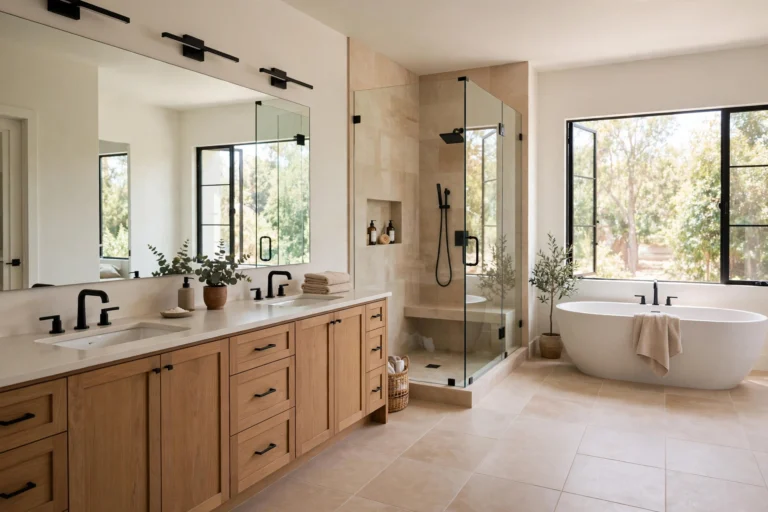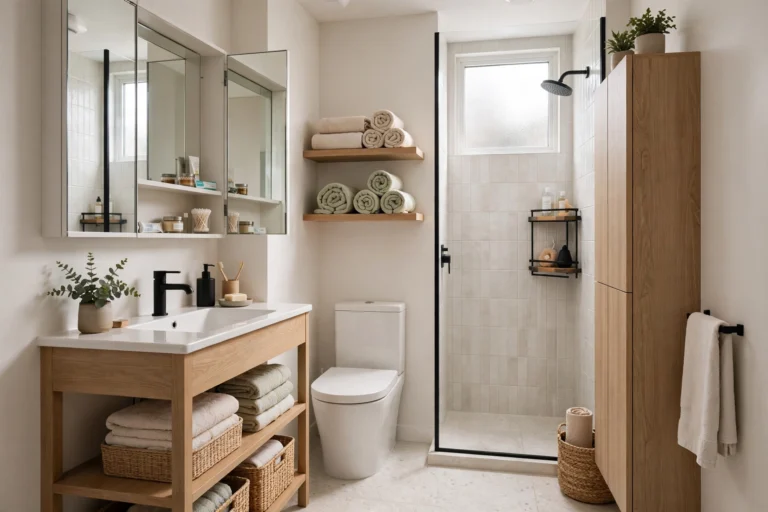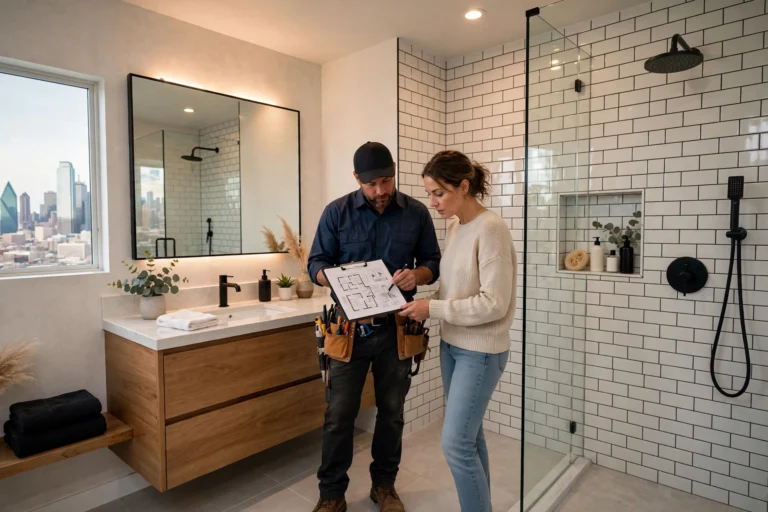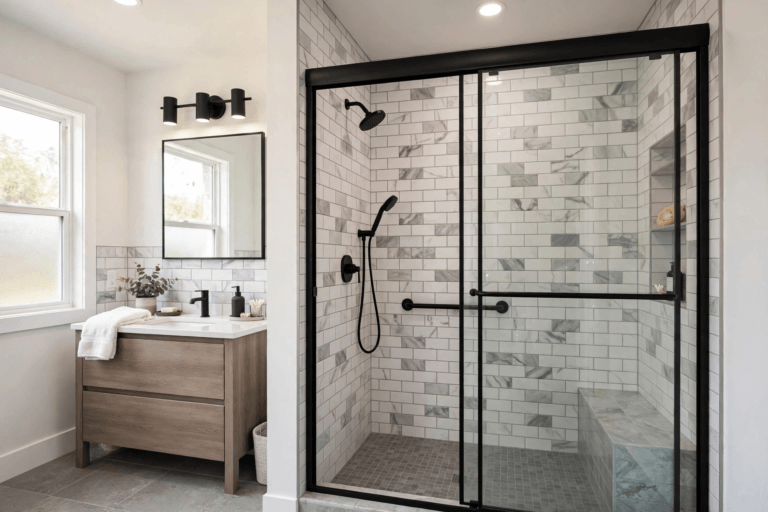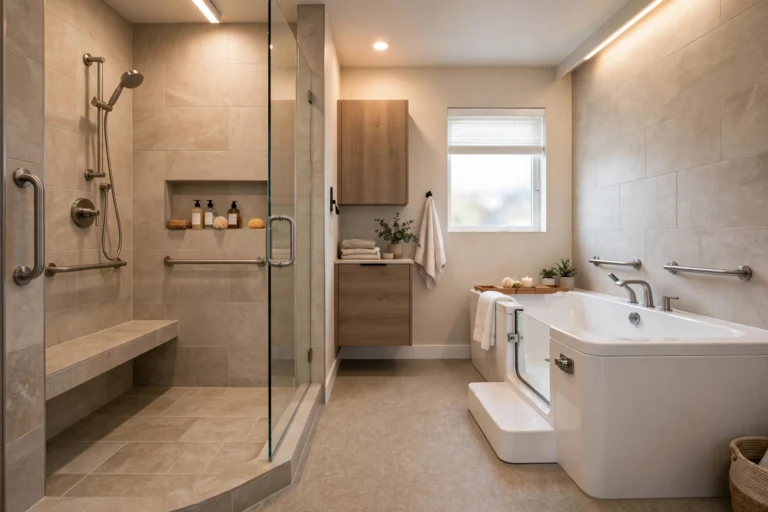
Houzz’s 2026 U.S. Bathroom Trends Study is out, and while most headlines focused on one thing — homeowners making their showers bigger (we covered that in our 2026 Dallas bathroom trends post) — the study also asked a more practical question: when people actually remodel, which fixtures, materials, and features do they choose? The answers are a useful shopping list for anyone planning a bathroom remodel in Dallas this year. Here’s what the data says.
Planning a remodel? Call +1 (972) 833-6266 for a free, no-pressure estimate — we’ll talk through what fits your space and your budget.
Low-curb showers are the new standard
Among homeowners upgrading their showers, low-curb designs are now the single most common choice at 47%, followed by alcove layouts at 41%. Corner showers rose six points to 24% (tying curbless), and 21% of upgraded showers now have dual showerheads. The biggest loser: shower-over-tub combos, down seven points to just 5% — homeowners are decisively moving away from them.
Color is shifting too. White still dominates shower walls at 34%, but beige gained five points to reach 13% while gray fell five points to 7%. Blue holds steady at 7%, and green showed up at 5%. On shower floors, tile rules at 79% — porcelain leads (42%), followed by ceramic (35%) and marble (11%). If a low-maintenance, modern shower is the goal, our walk-in shower page shows what these choices look like in Dallas homes, and a tub-to-shower conversion is the most common way homeowners here get there.
Soaking tubs are winning the tub debate
Here’s a number that surprised us: among homeowners who add or replace a bathtub, 72% now choose a soaking tub — up ten points from last year — while standard tubs fell ten points to 19%. Walk-in tubs account for just 2%. So when Dallas homeowners keep a tub, they increasingly want the deep-soak experience, not the builder-basic rectangle.
That said, 26% of renovating homeowners removed their tub entirely, and 79% of those used the freed space to enlarge the shower. It’s the clearest either/or in the study: big luxurious shower or a real soaking tub — rarely both. Our master bathroom remodeling guide walks through how to make that call based on your space and how long you plan to stay in the home.
Vanities go custom, quartz stays king
Custom-made vanities are the most popular choice at 38%, and combined with semicustom styles they account for 61% of vanity upgrades — stock models are down to 21%. Wood tones lead vanity colors at 31% (maple and white oak tied at 27% each among solid woods), followed by white at 19% and blue at 10%.
For countertops, engineered quartz remains the runaway leader at 46%, with quartzite second at 23% — more than double granite and marble, which tied at 11% each. White countertops (43%) and off-white (28%, up eight points) dominate. If you’re working with a tight footprint, see our small bathroom remodeling ideas — a well-designed custom vanity is often what makes a small bath feel twice its size.
Toilets are getting an upgrade too
Nearly half of renovating homeowners (47%, up nine points) now include specialty toilet features. Bidet toilet seats lead at 31%, followed by adjustable water pressure (30%), air dryers (28%), and heated seats (27%) — each up roughly ten points in a single year. Self-cleaning functions (22%) and nightlights (20%) are climbing fast too. What was a luxury-hotel novelty five years ago is becoming a standard line item.
The most-upgraded items overall
Across the whole bathroom, faucets are the #1 upgrade at 85%, followed closely by showers (84%, up nine points), lighting fixtures (83%), flooring (82%), wall finishes (80%), countertops (78%), and sinks (76%). Vanity cabinets were upgraded in 75% of renovations (up four points). Translation: homeowners are refreshing the things they touch and see every day — fixtures, light, and surfaces — rather than gutting for the sake of it.
Sustainability, driven by the wallet
Most renovating homeowners (82%) include sustainable options — but the motivation is practical: long-term cost-effectiveness leads at 66%, ahead of environmental friendliness at 56%. LED bulbs top the list (52%), followed by water-efficient fixtures (38%), timeless design that won’t need redoing (36%), and light dimmers (34%). In other words, “green” choices in 2026 are mostly the ones that also lower the utility bill. For a realistic sense of what these choices cost in our market, see our Dallas bathroom remodel cost breakdown.
What this means for your Dallas remodel
Trends are a starting point, not a prescription — the right choices depend on your home, your budget, and how long you’ll live there. But the 2026 data points in a clear direction: low-curb or curbless showers, soaking tubs for those who keep one, custom wood vanities with quartz tops, and smarter toilets and fixtures throughout.
Ready to plan yours? Call +1 (972) 833-6266 — Bathroom Remodeling Dallas — for a free estimate. We’ll walk through what fits your space and your budget, trend-informed but never trend-pushed.
What is the most popular bathroom upgrade in 2026?
According to Houzz’s 2026 U.S. Bathroom Trends Study, faucets top the list — upgraded in 85% of bathroom renovations — followed by showers (84%), lighting fixtures (83%), and flooring (82%). See how these fit into a full project on our services page.
Are low-curb showers worth it?
Homeowners seem to think so — low-curb designs are now the most common shower choice at 47%. They’re easier to step into, simpler to clean, and give a more open look. Explore options on our walk-in shower page.
Soaking tub vs. standard tub — what are homeowners choosing?
Soaking tubs by a wide margin: 72% chose a soaking tub, while standard tubs fell to 19%. Our master bathroom guide can help you decide.
What vanity countertop material is most popular in 2026?
Engineered quartz at 46% — more than double granite or marble (11% each). Quartzite is second at 23%.
Are bidet toilet seats worth adding during a remodel?
31% of renovating homeowners added bidet toilet seats, and 47% included some specialty toilet feature. Adding during a remodel is far cheaper than retrofitting later.