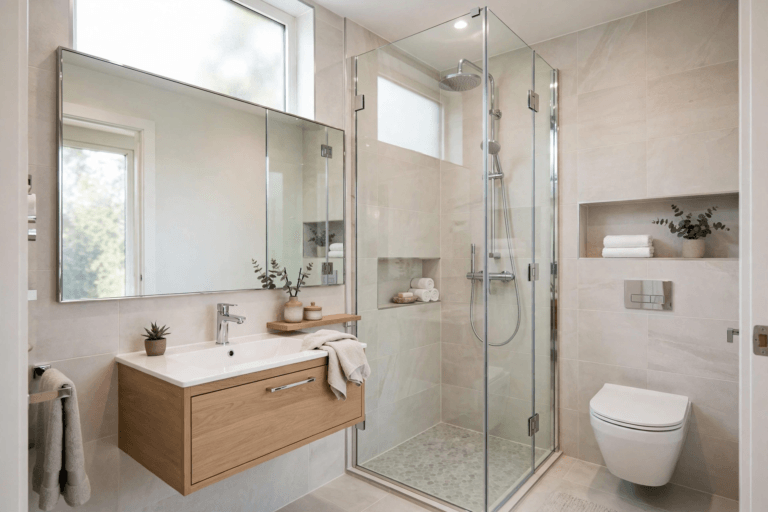
Most Dallas homeowners who plan to stay in their house for the next twenty years start with the same room: the bathroom. Roughly 78% of falls among older adults happen there, and a few well-chosen changes buy the most safety per dollar. Done well, it looks like a good modern bathroom — simply easier to use at every age.
The checklist below covers the changes that matter, in the order worth doing them. Costs are 2026 estimates, not quotes. Our Dallas bathroom remodel cost guide breaks down where the money goes. To talk through the checklist for your bathroom, call +1 (972) 833-6266.
1. Start with the shower: go curbless
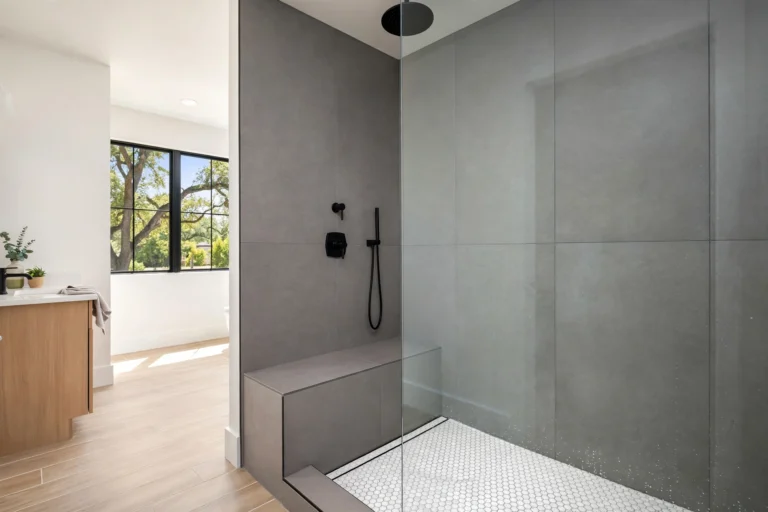
The shower is the single most important change. A standard tub wall is 14–18 inches you have to step over on a wet floor, and a raised shower curb is a smaller version of the same trip hazard. A curbless walk-in shower removes it entirely: the floor runs level into the stall, sloping gently toward the drain.
A curbless conversion typically runs $6,000–$10,000 installed in 2026, with custom tiled versions reaching $15,000 or more. In Dallas, slab foundations make the drain work the part to plan carefully. Pair it with a built-in bench (17–19 inches high) and a handheld showerhead on a slide bar, and the shower works seated or standing. Our curbless shower guide covers costs and drainage, and our tub-to-shower conversion page covers the full swap.
2. Grab bars — and the blocking behind them
Grab bars are the cheapest safety upgrade in the whole remodel — about $100–$350 per bar installed — and the one most often installed wrong. A bar screwed only into drywall will pull out under load. Bars need solid wood blocking inside the wall, rated for around 250 pounds, at 33–36 inches above the floor.
That is why the smart move is to add blocking during any remodel, even if you do not want bars yet — opening a finished wall later costs many times more. Place bars beside the toilet and along the shower wall. Match the bars to your faucet finish and they read as design, not hospital hardware — see how they fit into a walk-in shower layout.
3. Toilet, vanity, and fixtures at the right height
A comfort-height toilet sits 17–19 inches high — about two inches taller than standard — and that small difference makes sitting down and standing up noticeably easier on knees and hips. Installed cost is typically $400–$1,000.
At the vanity, look for knee clearance underneath if anyone might use the sink seated. Lever-handle faucets beat knobs for stiff hands. A double vanity works if clearances allow — 30 inches per person is the rule of thumb — and our vanity top comparison covers the most durable surfaces.
4. Flooring that grips when wet
Polished stone and glossy large-format tile look beautiful and are the wrong choice here. The floor needs texture: smaller tiles with more grout lines, textured porcelain, or slip-resistant vinyl. Our bathroom flooring guide ranks the humidity-proof options for Dallas homes — and Dallas humidity plus a wet floor is the combination that causes falls. Keep the hallway transition flush, too: a raised strip is a trip hazard and a barrier for a walker.
5. Light, handles, and doorway width
Good lighting is safety equipment. Layer it: bright overhead light, sconces at face height beside the mirror (around 60–70 inches), and a night light or motion-sensor light for 3 a.m. trips. Our bathroom lighting design guide covers Kelvin and brightness choices for aging eyes.
Swap knobs for lever handles — they open with a closed fist or an elbow. If the walls are open anyway, widen the bathroom doorway to 36 inches: cheap during a remodel, expensive as a standalone job, and what makes a bathroom usable with a walker.
6. What it costs in Dallas (2026)
Costs depend on scope, and every number below is an estimate, not a quote:
| Change | Typical cost (2026) |
|---|---|
| Safety hardware only (bars, handheld, raised seat, mats) | $500–$2,000 |
| Accessibility upgrades, existing layout kept | $8,000–$18,000 |
| Curbless walk-in shower conversion | $6,000–$10,000 |
| Walk-in tub | $4,000–$18,000 |
| Full accessible bathroom remodel | $8,000–$25,000 |
Spend first on the things that prevent falls — the shower entry, the bars, the floor — and last on finishes. A full accessible remodel averaging about $8,400 is far cheaper than a single fall: one hip fracture can cost $30,000 or more in medical expenses.
7. Do it in the right order
If you are not doing everything at once, sequence it so you never pay twice. First, anything inside the walls: grab-bar blocking, drain relocation, doorway widening. Second, the shower and floor. Third, fixtures: toilet, faucets, handles. Finishes and paint come last — see our bathroom remodel timeline.
Two practical notes for Dallas homes. In older Lakewood and Oak Cliff houses, original tub/shower combos and narrow doorways make the blocking and doorway work matter more. Check permits before structural work: our Dallas bathroom remodel permit guide explains when one is needed. For this kind of work, look for a Certified Aging-in-Place Specialist (CAPS) credential — our contractor guide covers the questions to ask.
Final call
Aging in place is not a separate kind of bathroom. It is a good bathroom, built with the next twenty years in mind: a shower you can walk into, bars that are there when you need them, a floor that grips, and a doorway wide enough for whatever comes next.
Ready to make your Dallas bathroom safer for the long term? Call +1 (972) 833-6266 to walk through the checklist for your home and get a realistic 2026 cost range for your scope.
What is the most important aging-in-place bathroom change?
The shower. A curbless walk-in shower removes the tub wall or curb you have to step over on a wet floor — the most common fall scenario. Our curbless shower guide covers costs, drainage, and the bench and grab-bar details that go with it.
How much does an aging-in-place bathroom remodel cost in Dallas?
Safety hardware alone runs about $500–$2,000; accessibility upgrades keeping the existing layout run $8,000–$18,000; a full accessible remodel runs $8,000–$25,000. Every figure is a 2026 estimate, not a quote. Our Dallas bathroom remodel cost guide breaks down where the money goes.
Do grab bars need to go into studs or blocking?
Yes — a bar screwed only into drywall will pull out under load. Bars need solid wood blocking inside the wall, rated to hold around 250 pounds of force, at 33–36 inches above the floor. Add blocking during any remodel, even if you do not want bars yet: opening a finished wall later costs many times more. See how bars fit into a walk-in shower layout.
Walk-in tub or walk-in shower for aging in place?
Most homeowners choose the walk-in shower: no door to open, no waiting for the tub to fill or drain, and it works seated or standing with a bench and handheld showerhead. A walk-in tub suits people who love soaking and can manage the door and the wait. We compare both in detail in walk-in tub vs. walk-in shower for seniors.
Do I need a permit for an aging-in-place bathroom remodel in Dallas?
It depends on the scope. Cosmetic work like grab bars and fixtures usually does not need one; moving plumbing, widening a doorway, or structural changes usually do. Our Dallas bathroom remodel permit guide explains when a permit is needed and who should pull it.