Dallas bathrooms punish floors. Steamy showers, slab-on-grade concrete that can wick moisture upward, and summer humidity that lingers after the fan stops — the wrong floor shows itself fast: cupped edges, moldy grout, planks swelling at the seams. The right choice? You never think about it again. Here’s how the real contenders compare in a Dallas home, with honest 2026 cost ranges.
Planning a Dallas bathroom remodel? Call +1 (972) 833-6266 for a free estimate — we’ll help you pick a floor that survives Texas humidity and looks great doing it.
What “humidity-proof” actually means
Waterproof means the material itself won’t be damaged by standing water — porcelain, or vinyl plank with a waterproof core. Water-resistant means it tolerates splashes and humidity but can fail if water sits or seeps through seams and grout. In a bathroom — the wettest room in the house — insist on waterproof. And remember: the floor is a system. The material matters, but so do the grout, the underlayment, and what’s underneath it all.
Porcelain tile: the gold standard
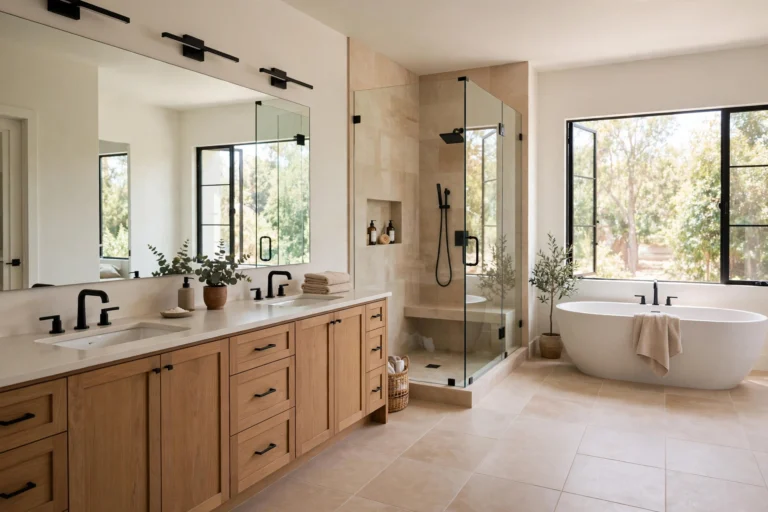
Porcelain tile is the best bathroom floor money can buy, and Dallas contractors overwhelmingly recommend it. It absorbs less than 0.5% water — the densest, least porous tile available — shrugs off steam and standing water, and lasts for decades. Larger-format tiles (12×24 and up) mean fewer grout lines to maintain, and wood-look porcelain gives you the warm aesthetic with none of the moisture risk.
Two details decide whether tile lives up to its reputation. First, slip resistance: look for a wet slip rating (DCOF) of 0.42 or higher — glossy polished tiles plus condensation are a fall waiting to happen. Second, grout: epoxy or high-performance grout resists mold far better than standard cement grout. Cost estimate: roughly $12–$25 per square foot installed in Dallas. For the walls to match, see our guide to tile vs. acrylic shower walls.
Luxury vinyl plank (LVP): the comfort pick
Luxury vinyl plank has become the strongest tile alternative in Texas bathrooms. Quality LVP with an SPC or WPC core is 100% waterproof, dimensionally stable (no expansion or contraction with humidity swings), and noticeably warmer and softer underfoot than tile. It installs as a floating click-lock floor, often right over level existing tile — cutting days and dollars off a refresh.
The caveats: durability is moderate next to porcelain — sharp grit can scratch it — and some manufacturers’ warranties get murky in full wet rooms, so check bathroom coverage in the fine print. Cost estimate: roughly $5–$12 per square foot installed. A great fit for a budget-friendly small bathroom remodel where speed and cost matter.
Natural stone: the luxury option
Marble, travertine, and slate bring character no manufactured floor can match, and they perform well in bathrooms — if properly sealed. Choose a honed or tumbled finish (not polished) for traction under bare wet feet, and plan on resealing every 1–3 years. One Dallas-specific note: our hard water leaves mineral deposits that can etch unsealed stone, so sealing isn’t optional here. Cost estimate: roughly $15–$45 per square foot installed, the natural choice for a high-end master bathroom remodel.
Budget corners: ceramic tile and sheet vinyl
Ceramic tile is porcelain’s more affordable cousin — slightly more porous but still solid, at roughly $8–$20 per square foot installed. Sheet vinyl is the cheapest waterproof option of all; modern prints look far better than the vinyl of decades past. Both are legitimate when the budget is the boss — just install them well.
What to avoid in a Dallas bathroom
Some materials are fundamentally wrong for bathrooms. Solid hardwood expands and contracts with humidity, leading to gaps and warped boards. Carpet traps moisture against the subfloor — a breeding ground for mold. Standard laminate has a fiberboard core that soaks up water like a sponge once water gets past the top layer. Even “waterproof laminate” is a gamble at the seams in a full bath. In Dallas humidity, don’t take the bet.
The details that decide how long it lasts
The material is only half the story. Most Dallas homes sit on slab-on-grade foundations, and concrete can wick moisture upward — a vapor barrier or moisture-mitigating underlayment is cheap insurance, especially under floating floors like LVP. Seal grout lines (or use epoxy grout), caulk tub-to-floor and wall-to-floor joints with silicone rather than grout, and run your exhaust fan 20 minutes after every shower — most flooring failures trace back to trapped humidity, not the floor. Adding a walk-in shower? A level, curbless entry keeps water off the bathroom floor.
2026 cost comparison at a glance
Installed cost estimates for a Dallas bathroom (material + labor; ranges vary with size and condition): LVP about $5–$12 per square foot, ceramic tile $8–$20, porcelain tile $12–$25, and natural stone $15–$45. A small powder room may floor for under $1,000; a large master bath runs several thousand, and subfloor repairs change the math. See our Dallas bathroom remodel cost guide and remodel timeline for how flooring fits the project.
Get a floor that survives Dallas humidity
The honest hierarchy for most Dallas homeowners: porcelain tile for the best, longest-lasting floor; LVP for waterproof comfort on a tighter budget; stone if the bathroom is the showpiece. Whatever you choose, the details — underlayment, grout, caulk, ventilation — matter as much as the material. Call +1 (972) 833-6266 — Bathroom Remodeling Dallas — for a free in-home estimate and straight advice on the right floor for your bathroom.
What is the best bathroom flooring for a Dallas home?
For most Dallas homeowners, porcelain tile is the best choice — it absorbs less than 0.5% water, handles steam and standing water, and lasts for decades. Luxury vinyl plank (LVP) is the best budget-friendly alternative: fully waterproof, warmer underfoot, and roughly $5–$12 per square foot installed. Choose tile with a wet slip-resistance (DCOF) rating of 0.42 or higher.
Is luxury vinyl plank really waterproof?
The plank material itself is 100% waterproof — quality LVP with an SPC or WPC core will not swell, warp, or rot. The vulnerability is at the seams and edges, where poor installation can let water underneath, and some manufacturers limit warranty coverage in full wet rooms. Professionally installed LVP with sealed perimeter edges performs well in Dallas bathrooms. See our small bathroom remodel guide for where LVP makes the most sense.
Can I install new bathroom flooring over my existing tile?
Often, yes. LVP can be installed as a floating floor over existing tile if it is level, firmly bonded, and in good condition — this can save significant time and labor. New tile can sometimes go over old tile with the right waterproofing membrane. Watch out for height changes at thresholds and doorways, and never layer over a floor that is loose, cracked, or showing moisture damage.
How much does it cost to replace bathroom flooring in Dallas in 2026?
As a 2026 estimate: LVP runs roughly $5–$12 per square foot installed, ceramic tile $8–$20, porcelain tile $12–$25, and natural stone $15–$45. A small powder room may floor for under $1,000 while a large master bath can run several thousand, and subfloor repairs add to the total. For the complete project budget, see our Dallas bathroom remodel cost guide.
Does bathroom flooring on a concrete slab need a vapor barrier in Dallas?
Yes — most Dallas homes sit on slab-on-grade foundations, and concrete can wick moisture upward into the flooring. A vapor barrier or moisture-mitigating underlayment is cheap insurance, especially under floating floors like LVP. A professional installer should moisture-test the slab before laying any floor. Pair the right underlayment with a properly sized exhaust fan and your floor assembly will handle Texas humidity for years.