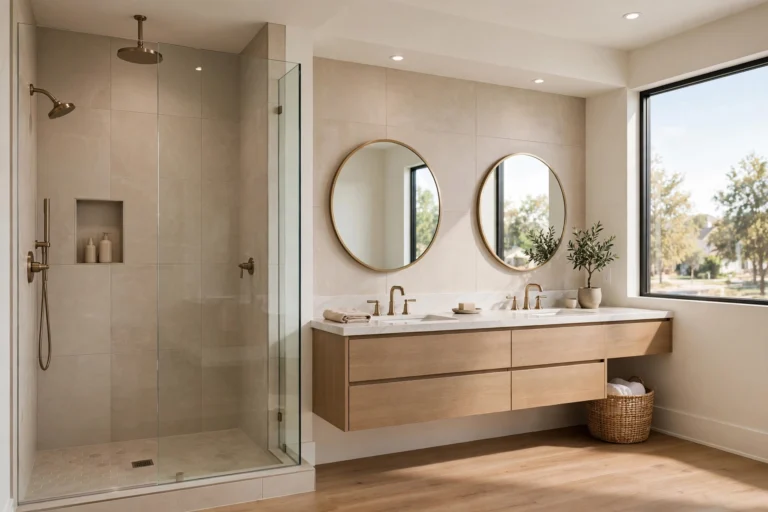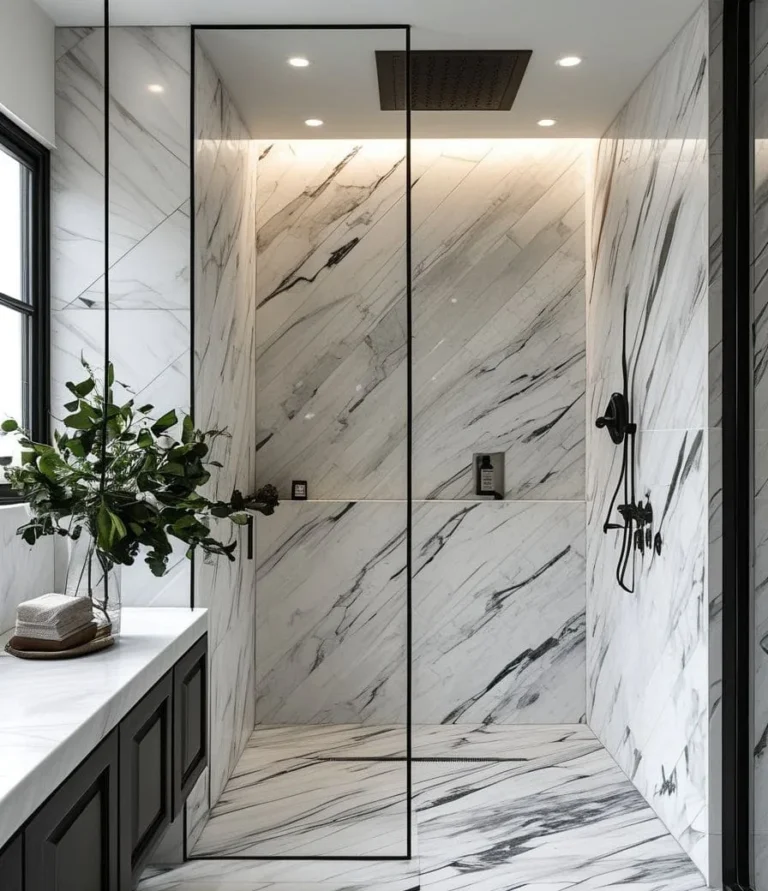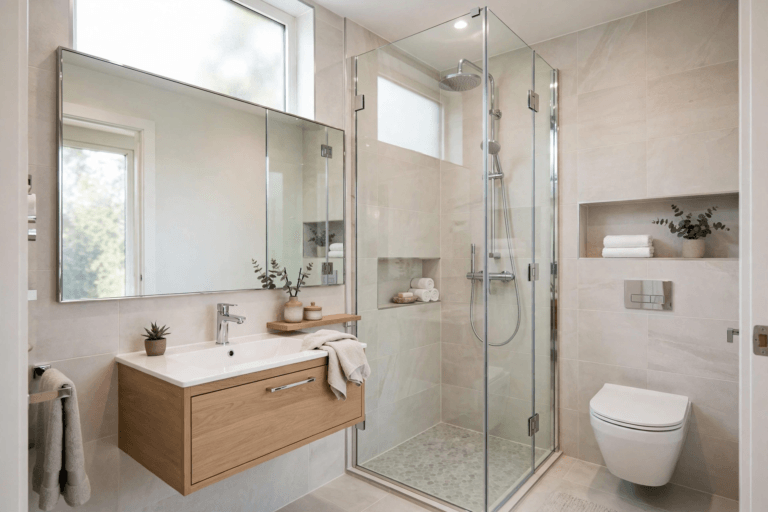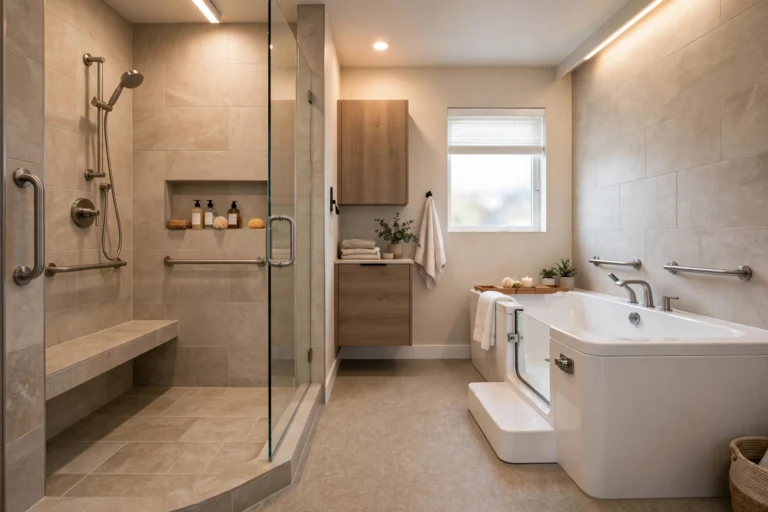
A freestanding tub is the photo every Dallas homeowner saves: an oval soaker under a window, nothing around it but tile and light. It looks effortless; the installation is anything but. Whether it is worth it comes down to four honest questions about your bathroom, not your taste. To talk through your own master bath, call +1 (972) 833-6266.
What a freestanding tub costs in Dallas
Acrylic tubs run about $500–$2,500, cast iron $1,500–$5,000, stone resin $2,000–$8,000, and copper $3,000–$10,000 or more. Labor adds $800–$3,000, and a floor-mounted faucet is a separate purchase. All in, a freestanding tub installed in Dallas typically runs $3,000–$12,000 — against $1,500–$4,000 for a standard alcove tub swap. Our Dallas bathroom remodel cost guide breaks down where remodel money goes.
The space test: does your master bath fit one?
A standard freestanding tub is about 60 inches long and 30 inches wide, with compact models near 54 inches. The tub alone is not the footprint: you need 6 to 12 inches of clearance on every side, and at least 12 inches on one side to step in and clean behind it — roughly 7 feet of clear floor length in practice. Under about 100 square feet, the tub eats the room and crowds the vanity and shower. See our master bathroom remodel layouts.
Plumbing: where the hidden costs live
A freestanding tub’s supply lines and drain come up through the floor, not out of the wall — and the drain must land within a fraction of an inch of the tub’s specified outlet. In a Dallas home on a slab foundation, moving a drain means cutting concrete, typically adding $1,000–$3,000 or more. The floor-mounted faucet needs its own rough-in, and the tub’s position is effectively permanent: moving it later means opening the floor again. If your drain already sits where the new tub needs it, you have saved the most expensive part of the job. Our bathroom remodel timeline shows where the rough-in fits.
Floor support: the 500–1,200 pound question
A tub full of water is heavy: a loaded soaker weighs roughly 500 to 1,200 pounds. A cast-iron tub can weigh 350 pounds empty. Standard residential floors are framed for about 40 pounds per square foot of live load, and a soaker concentrates its weight on a small footprint — on a second floor, that can exceed what the joists were built for locally. The fix — sistering joists or adding blocking — has to happen before the finished floor goes down. Lightweight acrylic tubs, under 100 pounds empty, usually need no structural work. Our bathroom flooring guide covers surfaces that handle a heavy, wet fixture best.
Hot water: will your water heater keep up?
A deep soaker can take 40 to 80 gallons to fill, and a 60-gallon tub will drain a small tank before it is full — leaving you topping off with cold water. Before you buy, check your water heater’s capacity and recovery rate, and confirm your supply lines deliver a strong flow. A tankless heater or a larger tank is often part of the real cost, even though it never appears in the tub’s price tag.
When it is worth it — and when it is not
It is worth it when three things are true: someone in the house actually takes baths at least weekly, the room has a separate shower, and there is enough floor space to leave clearance on every side. In that setting the tub is the centerpiece it promises to be — deeper soaks, better heat retention in cast iron or stone resin, and a room that feels like a spa.
It is not worth it when the tub would be the only bathing fixture, when baths are a few-times-a-year event, or when the room is tight. Without a separate shower, daily life gets awkward; in a small room, the tub crowds everything else and cleaning around its exposed base gets old fast. Families with young kids usually get more from a built-in tub-and-shower combo. We compare the same trade-off in walk-in tub vs. walk-in shower, and cover the safety side in our aging-in-place checklist.
The alternative many Dallas homeowners choose
If the tub fails the test, the money usually goes further in a walk-in shower: it uses the space better, needs no floor reinforcement, and is the feature most Dallas buyers look for first. Some split the difference — a generous shower plus a compact 54-inch soaker — but only in a genuinely large master bath. Before structural work, check whether a permit is needed: our Dallas bathroom remodel permit guide explains when one applies. And if resale is part of the math, see which bathroom upgrades add the most resale value — a spa tub helps, but a great shower helps more.
Final call
A freestanding tub is worth it in a Dallas master bath when you bathe often, you already have a separate shower, the floor can carry 500-plus pounds, and the plumbing does not need a slab cut. Miss two of those and the tub becomes an expensive sculpture you clean around. Get the four checks right, though, and it is the single most relaxing fixture in the house.
Want an honest read on your master bath? Call +1 (972) 833-6266 for a realistic 2026 cost range for the tub, the shower, or both.
How much does a freestanding tub cost installed in Dallas?
A typical installed freestanding tub runs $3,000–$12,000 in Dallas, depending on the material — acrylic $500–$2,500, cast iron $1,500–$5,000, stone resin $2,000–$8,000 — plus $800–$3,000 in labor. Moving a drain through a slab foundation can add $1,000–$3,000 more. Every figure is a 2026 estimate, not a quote. Our Dallas bathroom remodel cost guide breaks down the full budget.
How much space do you need around a freestanding tub?
A standard 60-by-30-inch tub needs 6 to 12 inches of clearance on every side, and at least 12 inches on one side for stepping in and cleaning. Plan on roughly 7 feet of clear floor length. In a master bath under about 100 square feet, the tub usually crowds the room — see our master bathroom remodel layouts for what fits.
Can a freestanding tub go on a second-floor bathroom?
Sometimes, but check the floor first. A loaded soaker weighs 500 to 1,200 pounds concentrated on a small footprint, and standard joists are framed for about 40 pounds per square foot. Heavy cast-iron or stone-resin tubs often need sistered joists or blocking; lightweight acrylic usually does not. Our bathroom flooring guide covers surfaces that handle the weight and water.
Does a freestanding tub include a shower?
No. A freestanding tub is a soaking tub only, with no shower and no ledge for bottles. If it is the only bathing fixture, daily showers become awkward. Most Dallas master baths pair the tub with a separate walk-in shower — or skip the tub and put the budget into the shower instead.
Do freestanding tubs add resale value in Dallas?
They add design appeal, and a beautiful soaker photographs well — but most buyers still want a great shower first. A freestanding tub without a separate shower can actually hurt resale. See which bathroom upgrades add the most resale value before deciding where the budget goes.