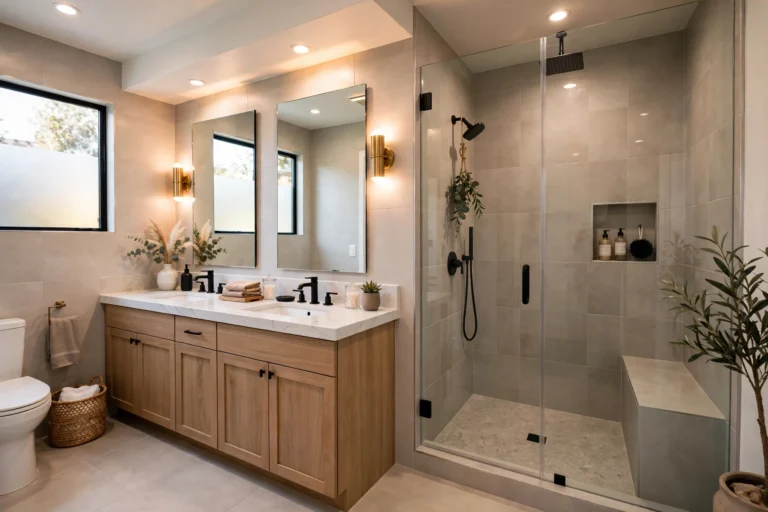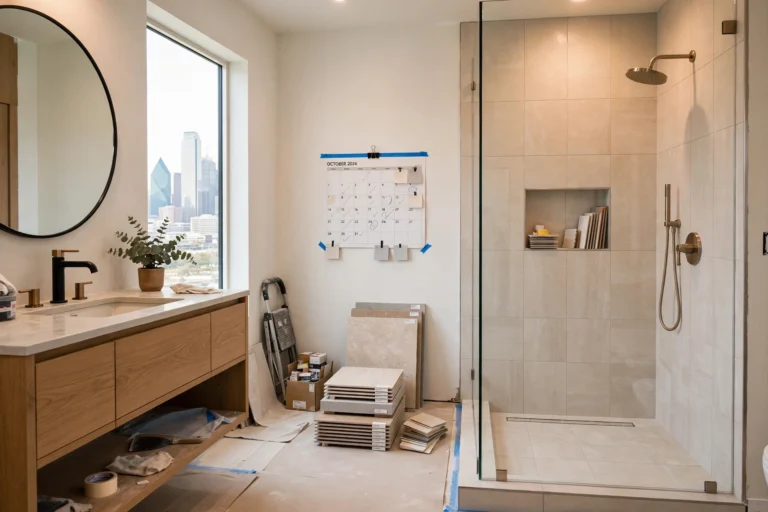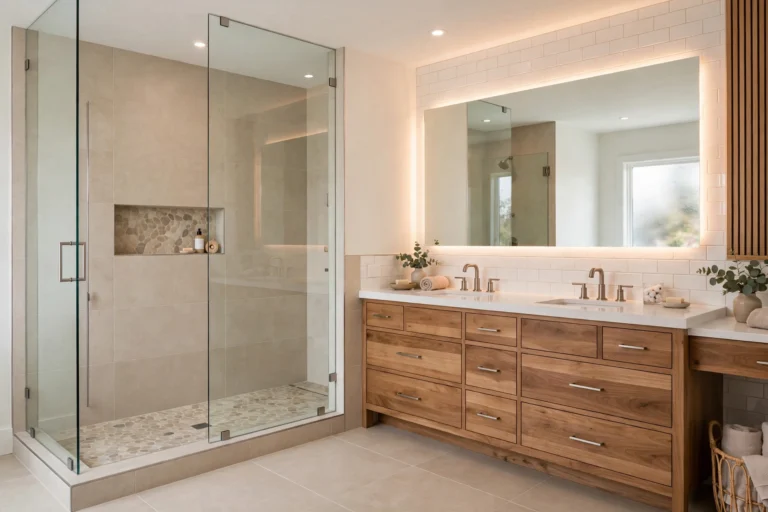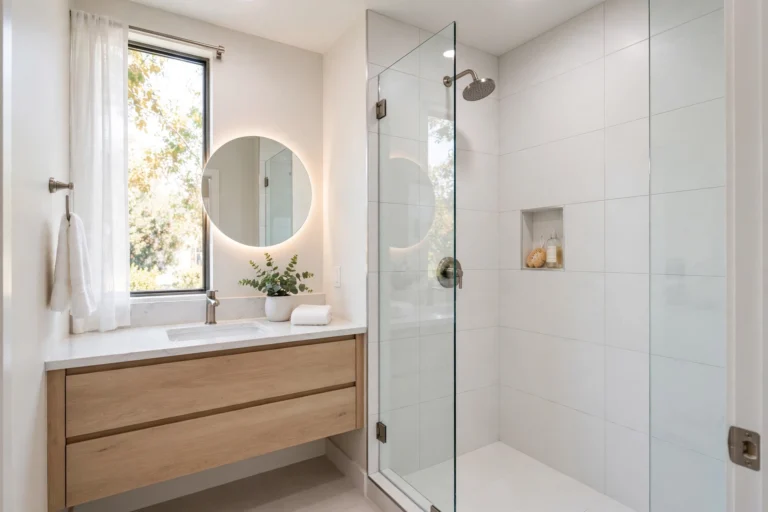
Walk into a curbless shower and there is nothing to step over — the bathroom floor continues into the shower and slopes toward the drain. No curb, no lip, no threshold to catch a toe. That is why curbless showers are among the most requested upgrades in Dallas remodels: they look high-end, they make a small room feel bigger, and they stay usable as mobility changes. They also cost more than a standard shower and punish sloppy work. Here is where the extra money goes and what can go wrong. Questions about your own bathroom? Call Bathroom Remodeling Dallas at (972) 833-6266.
What a curbless shower actually is
A curbless shower — also called a zero-threshold or barrier-free shower — has a finished floor flush with the surrounding bathroom floor. Water is contained not by a raised curb but by a carefully built slope, a drain placed to catch water before it leaves the shower zone, and waterproofing extending well beyond the shower itself. Most use a linear drain, a long narrow channel usually 24 to 48 inches wide, set at the entry or along one wall, plus a single fixed glass panel that blocks spray while keeping the open look. If you are comparing shower styles, our walk-in shower guide explains how curbless designs sit alongside standard curbed walk-ins.
What a curbless shower costs in Dallas
All prices here are estimates, not quotes — the final number depends on your floor structure, tile choice, and how much plumbing has to move. As a broad 2026 range, a professionally installed curbless shower in Dallas typically runs $8,000 to $18,000, with high-end custom tile and frameless glass pushing past $20,000. A standard custom tile walk-in without the curbless work usually lands lower, roughly $6,000 to $12,000. The premium pays for lowering the floor or raising the surrounding floor to create the slope, a linear drain, and waterproofing over a larger area. Keeping the shower in the same footprint as an old tub holds costs down; moving the drain adds hundreds to a few thousand dollars. See our Dallas remodel cost guide and timeline guide for the full picture.
The pros: why homeowners choose curbless
Accessibility is the strongest reason. With no threshold, a wheelchair, walker, or shower chair rolls straight in, and there is no step to trip over in a wet room — the same logic behind our walk-in tub vs. walk-in shower comparison for seniors. Building it during a planned remodel is far cheaper than retrofitting later. The second reason is space: removing the curb makes a bathroom read larger, which matters most in a small bathroom. Cleaning is easier too, with no curb edge collecting grime. Finally, universal-design features are increasingly expected by buyers, so a well-built curbless shower supports resale — see our bathroom upgrades that add resale value.
The cons: where curbless showers go wrong
A curbless shower has no curb to forgive mistakes, so the slope and waterproofing have to be right. The standard rule is a slope of about 1/4 inch per foot toward the drain — too flat and water pools, too steep and the floor feels odd underfoot. The waterproofing membrane must run continuously under the shower floor and out onto the surrounding bathroom floor, because any water that escapes has no barrier to stop it. That is why proper ventilation and slip-resistant flooring matter even more here: a wet floor that cannot dry invites mold, and smooth tile on a sloped wet surface is a fall risk. Use tile rated DCOF 0.42 or higher.
Dallas slab homes: the detail that changes the price
Many Dallas-area homes sit on concrete slabs, and that changes how a curbless shower is built. On a wood-framed second floor, the subfloor can sometimes be lowered between joists. On a slab, the drain and slope have to go into the concrete — usually cutting or trenching the slab — or the surrounding floor is built up with a gentle ramp. Both are structural work, not finish work, and a big reason a slab-home curbless shower can land at the higher end of the cost range. Permits can also come in, so check our Dallas permit guide before work starts. If a contractor quotes a curbless shower on a slab home without looking at the floor, that is a red flag.
Curbless vs. curbed: which should you choose?
Choose curbless if accessibility is a priority, if the bathroom is small and you want it to feel open, or if you plan to stay long-term and want a shower that will not need rebuilding as mobility changes. Choose a curbed shower if budget is tight, if the bathroom is on a slab and you want to avoid structural floor work, or if you prefer a fully enclosed shower with a door. A good middle ground is a low-threshold shower — a curb of an inch or less — which keeps most of the open look while avoiding the full recessed-floor build. Either way, long-term performance comes down to continuous waterproofing, a correct slope, and a drain sized for your showerhead’s flow. Our tile vs. acrylic guide and frameless vs. framed doors comparison cover the finish choices that pair with either design.
A curbless shower is not the cheapest shower you can buy, but for the right home it is the one you will be happiest living with for the longest time. Get the floor assessed first and insist on full waterproofing and a linear drain. Ready to talk through what a curbless shower would take in your bathroom? Call Bathroom Remodeling Dallas at (972) 833-6266.
How much does a curbless shower cost in Dallas?
As estimates, a professionally installed curbless shower in Dallas typically runs $8,000 to $18,000, with high-end custom tile and frameless glass pushing past $20,000. Slab homes often land higher because cutting the slab or building up the floor adds structural work. See our Dallas remodel cost guide for how shower costs fit a full remodel budget.
Can a curbless shower be installed on a concrete slab?
Yes, but it takes structural work: the slab is usually cut or trenched to set the drain below finished-floor height, or the surrounding bathroom floor is built up to meet the shower. Either way the floor must be assessed before quoting. Our Dallas permit guide explains when plumbing and structural work trigger a permit.
Will water escape a shower with no curb?
Not when it is built correctly. Water containment depends on a slope of about 1/4 inch per foot toward the drain, a linear drain placed to catch water at the entry, and waterproofing that extends beyond the shower. A fixed glass panel blocks most spray. Problems come from flat slopes or skipped waterproofing, not from the missing curb itself.
Is a curbless shower good for aging in place?
Yes — it is one of the best aging-in-place upgrades, since there is no threshold to step over and a wheelchair or shower chair can roll straight in. Pair it with grab bars, a handheld showerhead, and slip-resistant tile. Our walk-in tub vs. walk-in shower guide for seniors compares the other accessible options.
Curbless or curbed shower — which adds more resale value?
A well-built curbless shower generally appeals to more buyers, especially in a primary bathroom, because it reads as modern and accessible. But a curbed shower is not a resale liability — buyers care more about a clean, well-built shower than about the threshold style. See our ranked bathroom upgrades for resale value for where showers sit overall.